

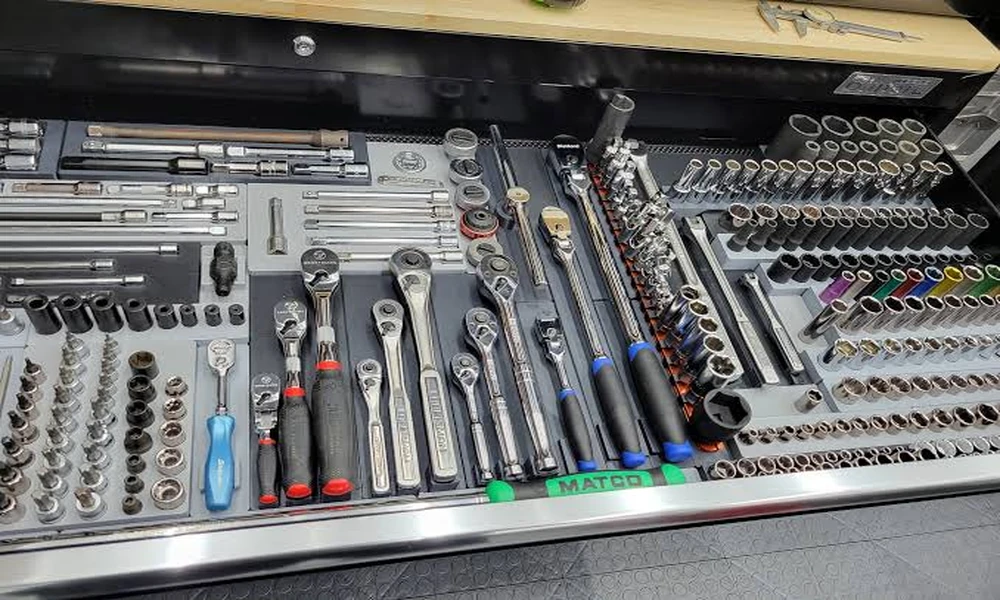
Anyone who has emptied a toolbox onto the floor to find one drill bit understands the problem. A single open cavity means everything settles to the bottom in a layer, small items disappear beneath large ones, and the time spent looking exceeds the time spent working. A toolbox with compartments solves this by giving each category a defined home, which is less about tidiness than about not wasting twenty minutes a day.
Match the Layout to What You Carry
Compartment configuration should follow your actual kit rather than the photograph on the box. Someone carrying mostly hand tools needs a deep main cavity with a shallow tray above. Someone working with fasteners, terminals and small components needs many small dividers and very little open space. An electrician’s requirements differ from a plumber’s, which differ again from a household toolbox that has to hold a drill, a saw and a jar of assorted screws. Lay your tools out on a table before choosing.
The Common Formats
The cantilever design opens to present tiered trays that lift and spread as the lid rises, giving visibility of everything at once, and it suits people who work from a fixed spot. The tote with a removable tray is simpler and more robust, and better for carrying up a ladder. Organiser cases with fixed or adjustable dividers suit small parts exclusively. Stackable modular systems that clip together let a large kit be broken into loads one person can carry, which matters more than it sounds when the job is on the third floor.
Adjustable Dividers Are Worth Paying For
Fixed compartments lock you into whatever the manufacturer imagined. Removable dividers let the layout change as your work changes, and let a single case handle wall anchors this month and cable glands next. Check that dividers actually seat firmly, because loose ones migrate during transport and mix the contents anyway, which defeats the purpose entirely. Give the case a shake before buying if you can.
Material and Construction
Polypropylene is the standard for good reason, it resists impact, tolerates oils and solvents, does not rust, and stays serviceable in a damp store. Check wall thickness by pressing the side, since a case that flexes noticeably will crack at a corner after a few drops. Look at the hinge, which is the most common failure point, and at the latches, since a latch that opens when the box is knocked will eventually empty itself down a staircase. Metal-reinforced latches outlast moulded plastic ones.
Carrying and Weight
A well-organised box invites you to fill it, and a full one gets heavy fast. Consider whether the handle is comfortable under real load, whether the case balances or tips when carried, and whether a shoulder strap or wheels make sense for the distances involved. Two medium cases are frequently more practical than one large one, since they can be carried in a single trip and only the relevant one needs opening at the work face.
Weather and Site Conditions
If the box travels in a van bed or lives on site, water resistance matters. A gasket around the lid and latches that pull the seal down keep out rain and dust. In humid conditions, tools stored damp in a sealed case will corrode faster than tools left in open air, so dry things before closing and consider a small desiccant sachet with anything prone to rust. Providers of industrial storage cases will usually specify whether a model is sealed or merely covered.
Security and Shared Kit
Where a box is left on site overnight or shared between staff, a hasp that accepts a padlock is worth having, even though a plastic case is never genuinely secure. More useful in practice is accountability: a photograph of the packed layout taped inside the lid makes a missing tool obvious at a glance, which resolves most of the quiet attrition that affects shared kit. For teams, issuing individual cases rather than one communal box removes the argument entirely, and the cost difference is recovered the first time nobody has to buy a replacement impact driver.
A System That Survives the Week
Organisation fails at the point of putting things back, not taking them out. Two habits fix most of it. Give every compartment one category and label it, so a tool without a home becomes obvious. And reset the box at the end of each job rather than at the end of the week, because a case repacked while you still remember what came out of where takes two minutes and one repacked on Friday takes half an hour.
Small Parts Deserve Their Own Case
Screws, anchors, terminals, o-rings and washers behave differently from tools. They are light, numerous, and catastrophic when mixed. A separate organiser case with fixed compartments and a lid that seals against each cell, rather than one lid over an open tray, prevents migration during transport. Keeping consumables separate also means the tool case does not need opening every time a fastener is required.
Buying Once
Work out what you carry, choose a format that matches how you work, prioritise adjustable dividers, secure latches and a solid hinge, and buy slightly more capacity than you need today. A good toolbox with compartments is a purchase that quietly pays for itself in time saved, and the cheap one bought first usually ends up as the spare that holds paint rollers.